- Color paste
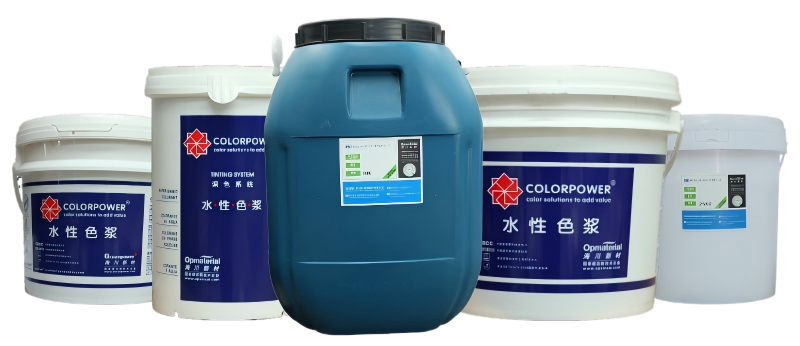
CP Factory Color Matching Series Pigments
- auxiliary agent
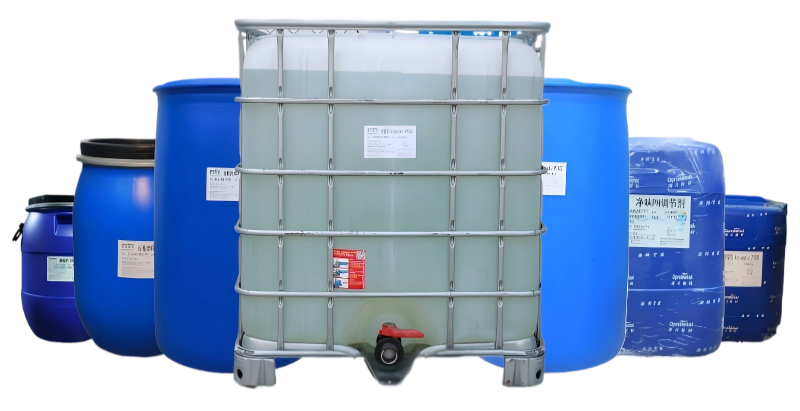
auxiliary agent

ln-Depth Analysis of Various Causes of Post-Thickening in Coatings

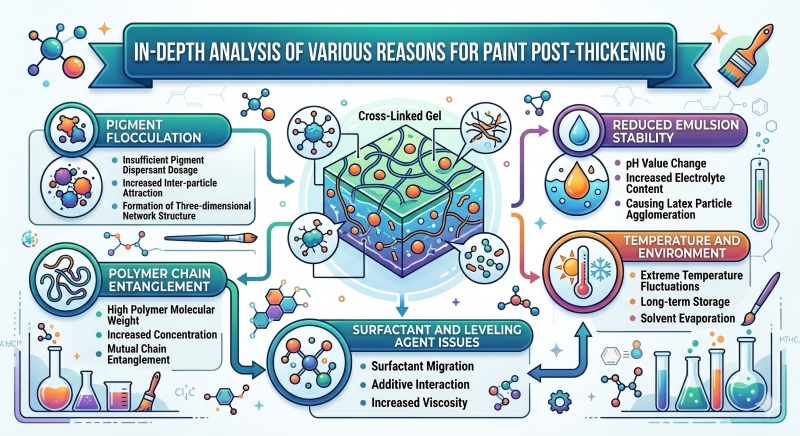
In-Depth Analysis of Various Causes of Post-Thickening in Coatings
Many coatings technicians have encountered the problem of post-thickening during production and storage. This article provides a comprehensive analysis of the definition, manifestations, hazards, core mechanisms, and targeted solutions for coating post-thickening to support stable formula design and quality control.
What is Coating Post-Thickening?
Post-thickening refers to the unexpected and continuous increase in viscosity of coatings after production and during storage. It is not a trivial issue but indicates structural and chemical changes inside the coating system.
Typical Manifestations
Significant rise in low-shear viscosity, resulting in poor fluidity under low shear force
Expansion of thixotropic loop area, indicating enhanced thixotropy
Severe cases lead to gelation, where the coating transforms from liquid to a gel-like state
Adverse Effects of Post-Thickening
Constructability: Poor leveling, brush marks, and stringing, reducing construction efficiency and finish quality
Quality: Coating defects, uneven color, and degraded film performance
Economics: Product scrappage, increased rework costs, and brand reputation damage
Safety: Increased internal tank pressure, leakage risks, and threats to personnel and the environment
Essential Nature of Post-Thickening
Coating post-thickening essentially means the original dynamic equilibrium of the colloidal system is broken, and the system evolves toward a lower-energy but higher-viscosity state. Initially, thickeners, dispersants, pigments, and other components form a stable microstructure. Over storage time, physical adsorption, chemical reactions, or structural rearrangement continuously disrupt the balance, eventually causing viscosity rise.
Core Mechanisms of Coating Post-Thickening
Mechanism
1: Network Evolution of Associative Thickeners
Associative thickeners (e.g., HEUR) are the main triggers of post-thickening. They form a 3D network by bridging latex and pigment particles via hydrophobic end groups. During storage, this network continuously reconstructs and strengthens, leading to gradual viscosity increase.
Key sub-mechanisms:
Slow adsorption and association: Thickeners start in a coiled state and gradually stretch to form tighter junction points
Competitive adsorption and network rearrangement: Thickeners may displace dispersants from particle surfaces, forming stronger bridges or destabilizing dispersion, both causing sustained viscosity growth
Mechanism
2: Latex Particle Swelling Effect
Coalescents such as ethylene glycol and propylene glycol slowly penetrate into latex particles, increasing particle volume fraction and system viscosity. Meanwhile, changes in latex surface hydrophobicity alter thickener adsorption, further accelerating post-thickening.
Mechanism
3: Pigment and Filler Dispersion Instability
This mechanism often causes sharp viscosity surges:
Dispersant desorption and re-flocculation: Dispersants detach from pigment surfaces under temperature, pH, or competitive adsorption effects; pigments re-flocculate under van der Waals forces, reducing free water volume and raising viscosity
Uncontrolled bridging flocculation: Excessive or high-molecular-weight thickeners induce irreversible bridging, making the network overly rigid and increasing viscosity continuously
Matting agent adsorption: Matting agents, with high specific surface area and porous structure, strongly adsorb thickeners, dispersants, and water, breaking formula balance and worsening post-thickening
Mechanism
4: Slow Chemical Cross-Linking Reactions
Two-component systems: Unreacted functional groups (e.g., NCO, amino) continue cross-linking during storage
One-component systems: Residual self-crosslinkable groups or trace initiators polymerize slowly
Both pathways increase molecular weight, leading to sharp viscosity rise and even gelation.
Mechanism
5: Post-Neutralization of ASE & HASE Thickeners
ASE/HASE thickeners rely on alkaline neutralization of carboxyl groups to stretch polymer chains. Two instability factors:
Incomplete neutralization: Residual acidic groups neutralize gradually, causing continuous viscosity increase
pH drift: Reactions with acidic pigments destroy the network structure
Mechanism
6: Hydration of Non-Associative Thickeners (e.g., HEC)
Hydroxyethyl cellulose (HEC) requires time for water to penetrate and fully swell. As hydration proceeds, chain segments stretch, leading to slow but long-term