- Color paste
CP Factory Color Matching Series Pigments
- auxiliary agent
auxiliary agent

Thixotropic Agents & Anti-settling Agents:Performance Analysis and ApplicationGuide

Thixotropic Agents & Anti-settling Agents: Performance Analysis and Application Guide
What’s the core difference between anti-settling agents and thickeners? Both play pivotal roles in coating production and application, yet their functional positioning and working mechanisms remain confusing to many. This article delves into their core characteristics and practical applications, especially in color paste formulations, to provide a professional reference for rational material selection.
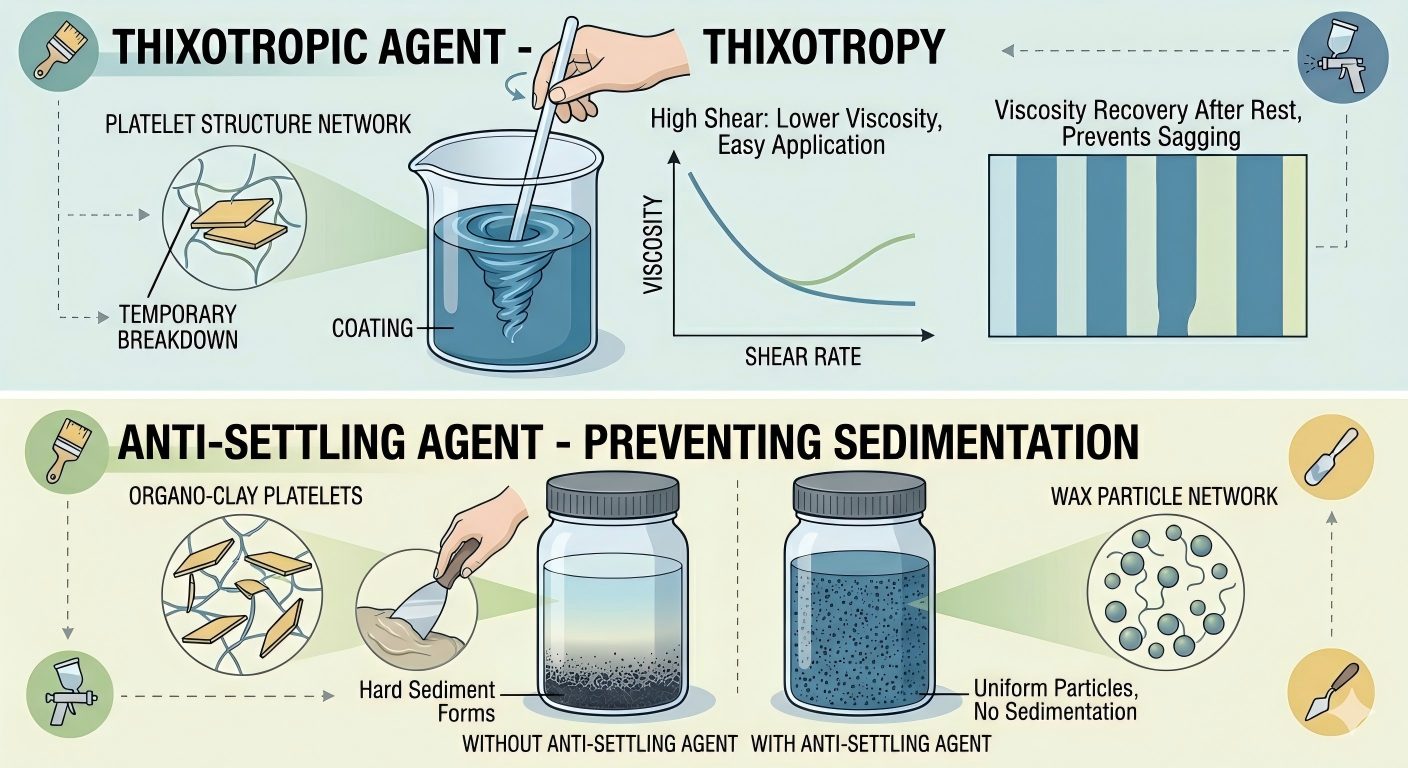
Anti-settling agents focus on preventing pigment/filler settling during storage by maintaining the suspended state of the dispersed phase, ensuring stable performance of coatings and color paste during long-term storage. Without them, pigments and fillers are prone to precipitation and hard caking, which directly impairs the quality and application effect of coatings and color paste.
Thickeners are core additives for adjusting system viscosity, which can effectively improve the low-shear and high-shear viscosity of coating and color paste systems, balance the leveling property and anti-sagging performance during construction, and also assist in enhancing the suspension stability of dispersed phases to a certain extent.
The core anti-settling mechanisms of anti-settling agents for color paste include rheology control and dispersion stabilization: the rheology-controlled type builds a colloidal network by improving low-shear viscosity to physically block pigment settling; the dispersion-stabilized type adsorbs on the pigment surface to provide charge or steric hindrance, keeping pigment particles separated and avoiding aggregation and settling.
Thickeners regulate the viscosity of color paste systems through different mechanisms: inorganic thickeners rely on high specific surface area to form a network structure and increase viscosity; organic thickeners adjust the system viscosity through molecular chain entanglement and hydration, and polymer thickeners can realize precise viscosity control of color paste for different construction scenarios.
In color paste formulation design, the synergistic use of anti-settling agents and thickeners is the key to ensuring long-term storage stability and construction performance. Anti-settling agents are the main force to prevent pigment flocculation and settling, and the addition amount is generally controlled at 0.5%~5.0% according to the pigment volume concentration; thickeners are used to adjust the overall viscosity of the color paste system, and the dosage is optimized according to the construction method (spraying, brushing, rolling) to balance fluidity and anti-sagging.
For high-pigment-content color paste, the selection of anti-settling agents needs to focus on strong adsorption and dispersion stability, and matching with thickeners with good compatibility can avoid the problem of viscosity mutation and poor redispersibility of color paste after long-term storage. For water-based color paste, water-based special anti-settling agents and thickeners are preferred to ensure the system’s compatibility and environmental protection performance, and avoid demulsification and delamination.
A common problem in color paste production and storage is pigment settling and uneven color, which can be solved by adding 0.8% nonionic polyoxyethylene fatty amine anti-settling agents and matching with appropriate thickeners: the anti-settling agents can effectively reduce the pigment particle size and lower the settling rate by 80%, and the thickeners can maintain the stable viscosity of the color paste system, ensuring uniform color and good redispersibility during use.
In the formulation of color paste, the process control of anti-settling agents and thickeners is also crucial: anti-settling agents are recommended to be added before grinding to make them fully contact with pigments and exert the best anti-settling effect; thickeners are generally added in the later stage of formulation to avoid excessive shear during grinding and damage to the thickening structure, and the pH value and temperature of the system need to be strictly controlled to ensure the stability of thickeners performance.